Queer Places:
Harvard University (Ivy League), 2 Kirkland St, Cambridge, MA 02138
Laurel Hill East Cemetery, 3822 Ridge Ave, Philadelphia, PA 19132, United States
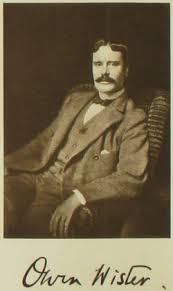 Owen Wister (July 14, 1860 – July 21, 1938) was born on July 14, 1860, in Philadelphia, Pennsylvania, into an affluent and culturally refined family. As a young man, he
attended Harvard University, where he initially pursued a passion for classical music and composition, graduating with honors in 1882. During his undergraduate years, he
became deeply embedded in elite campus culture as a prominent member of the prestigious Porcellian Club. Suffering from bouts of neurasthenia and depression brought on by
family pressures to abandon music for a conventional legal career, Wister traveled to the American West in the late 1880s and 1890s to recuperate. These health-seeking trips
to Wyoming—amidst the sweeping landscapes and cattle culture of the frontier—proved to be the defining turning point of his life and artistic output.
Owen Wister (July 14, 1860 – July 21, 1938) was born on July 14, 1860, in Philadelphia, Pennsylvania, into an affluent and culturally refined family. As a young man, he
attended Harvard University, where he initially pursued a passion for classical music and composition, graduating with honors in 1882. During his undergraduate years, he
became deeply embedded in elite campus culture as a prominent member of the prestigious Porcellian Club. Suffering from bouts of neurasthenia and depression brought on by
family pressures to abandon music for a conventional legal career, Wister traveled to the American West in the late 1880s and 1890s to recuperate. These health-seeking trips
to Wyoming—amidst the sweeping landscapes and cattle culture of the frontier—proved to be the defining turning point of his life and artistic output.
Encouraged by his lifelong friend and Harvard classmate, Theodore Roosevelt, Wister began translating his Western experiences into fiction. His early short stories
published in Harper's Magazine established his literary reputation, but it was his 1902 masterpiece, The Virginian: A Horseman of the Plains, that cemented his legacy. The
Virginian single-handedly invented the modern American Western novel, establishing enduring archetypes of cowboy masculinity, rugged individualism, and frontier justice.
Beyond his Western writing, Wister penned the popular Harvard-themed campus novel Philosophy 4, served actively on Harvard's Board of Overseers, and wrote widely on politics
and history, including a biographical memoir of his close friend, Roosevelt: The Story of a Friendship, 1880–1919. In 1898, Wister married Mary Channing, with whom he had
several children, though she tragically passed away in 1913. Wister spent his later years continuing to write and manage his literary legacy until his death from a cerebral
hemorrhage on July 21, 1938, in North Kingstown, Rhode Island.
Within modern literary criticism and queer history, Wister's life and works hold a fascinating place regarding late-nineteenth-century homosociality and implicit LGBTQ
connections. While Wister lived a conventionally public heterosexual life—culminating in his marriage—his personal background and most famous writings deeply reflect the
intense, exclusive male bonds characteristic of the Victorian elite. Scholars examining the structures of turn-of-the-century masculinity frequently point out the profound
homosocial and homoerotic subtexts embedded in The Virginian. The narrative heavily focuses on passionate, rock-solid same-sex companionship between frontiersmen—such as the
intense bonds shared between the hero and characters like Steve—which often eclipse the novel's nominal heterosexual romance. Furthermore, the book's Eastern male narrator
displays a deeply sublimated, romanticized fascination with the titular cowboy.
Wister's personal alignment with figures like Theodore Roosevelt and Charles Warren Stoddard’s milieu places him
squarely within a network of elite American men who channeled physical neurasthenia into hyper-masculine outlets—such as big-weight training, rigorous athletics, and
big-game hunting—while simultaneously cultivating deeply intimate, lifelong same-sex fraternities. These homosocial structures, institutionalized at Harvard clubs and
fostered on the Western frontier, provided a socially acceptable framework for intense male emotional and physical intimacy during an era before modern conceptualizations of
sexual orientation were fully formed.
References:
Other references:
- Library of Congress (Manuscript Division): The primary collection of Owen Wister Papers (comprising over 26,000 items, including extensive correspondence, journals, diaries, manuscripts, and drafts of The Virginian and his other works).
- Harvard University (Houghton Library): Houses auxiliary letters, manuscripts, and institutional records relating to Wister's undergraduate years, the Porcellian Club, and his tenure on the Board of Overseers.
- University of Wyoming (American Heritage Center): Preserves regional manuscripts, western papers, and research materials connected to his frontier travels.
- Owen Wister Out West: His Journals and Letters (1958), edited by Fanny Kemble Wister.
- My Dear Wister—The Frederic Remington-Owen Wister Letters (1972), edited by Ben Merchant Vorpahl.
- The Virginian: A Horseman of the Plains (New York: Macmillan, 1902) — His defining frontier novel.
- Philosophy 4: A Story of Harvard University (New York: Macmillan, 1903) — A campus novella capturing elite undergraduate life.
- Roosevelt: The Story of a Friendship, 1880–1919 (New York: Macmillan, 1930) — A historical and personal memoir detailing his lifelong bond with Theodore Roosevelt.
- Red Men and White (1895) and Members of the Family (1911) — Collections of influential Western short stories.
- Cobbs, John L. Owen Wister. Boston: Twayne Publishers, 1984.
- Payne, Darwin. Owen Wister: Chronicler of the West, Gentleman of the East. Dallas: Southern Methodist University Press, 1985.
- Scharnhorst, Gary. Owen Wister and the West. Norman: University of Oklahoma Press, 2015.
- White, G. Edward. The Eastern Establishment and the Western Experience: The West of Frederic Remington, Theodore Roosevelt, and Owen Wister. New Haven: Yale University Press, 1968 (reprinted by University of Texas Press, 2012).
- Etulain, Richard W. Owen Wister. Boise: Boise State College, 1973.
Support this project
This website is a passion project researched, developed, and funded entirely by me. If you find the content valuable and would like to help support the ongoing research and hosting costs, any contribution is deeply appreciated.
Thank you for keeping this independent resource alive!
My books on Amazon: Elisa Rolle's books
BACK TO HOME PAGE
